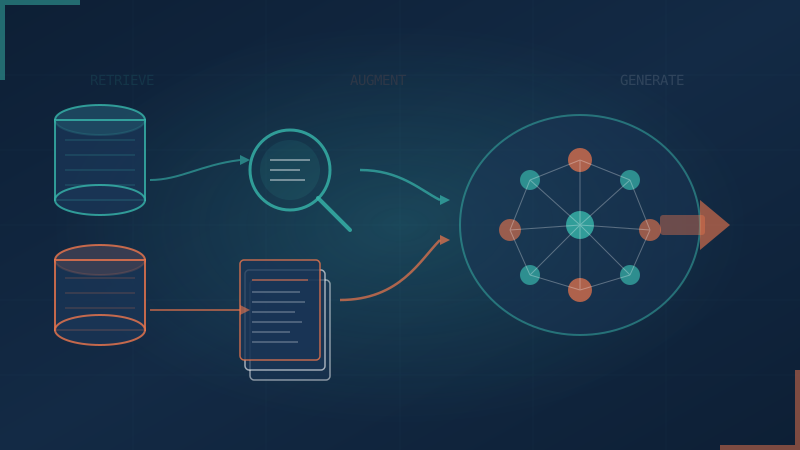
Retrieval-Augmented Generation (RAG) has become the dominant architectural pattern for enterprise generative AI applications. But implementing a RAG system that truly works in production requires skills far beyond basic tutorials.
Beyond naive RAG
The simplest RAG implementation — document chunking, embedding, similarity search, generation — produces acceptable results only in very simple contexts. Real enterprise scenarios require more sophisticated strategies: semantic chunking, hierarchical embeddings, re-ranking, query expansion, and hybrid search.
Chunking and preprocessing: where you win or lose
RAG system quality depends 70% on preprocessing. Chunking must respect content's semantic structure. A chunk that splits a table in half or separates a question from its answer produces disastrous results. At Adalot, we use contextual chunking pipelines that analyze document structure before splitting.
Vector databases and hybrid search
Vector database choice (Pinecone, Weaviate, Qdrant, pgvector) depends on scale, latency, and feature requirements. The hybrid search approach, combining semantic with traditional keyword search (BM25), offers significantly better results, especially for technical queries.
Evaluation and monitoring
A often-neglected aspect is systematic RAG system evaluation. Metrics like faithfulness, relevance, and completeness must be continuously monitored in production.
When RAG isn't enough
RAG isn't the solution to every problem. For tasks requiring multi-step reasoning, structured data manipulation, or action execution, RAG must be integrated with agentic architectures. Knowing when to use RAG and when to shift to more complex approaches is a key competency Adalot brings to its clients.