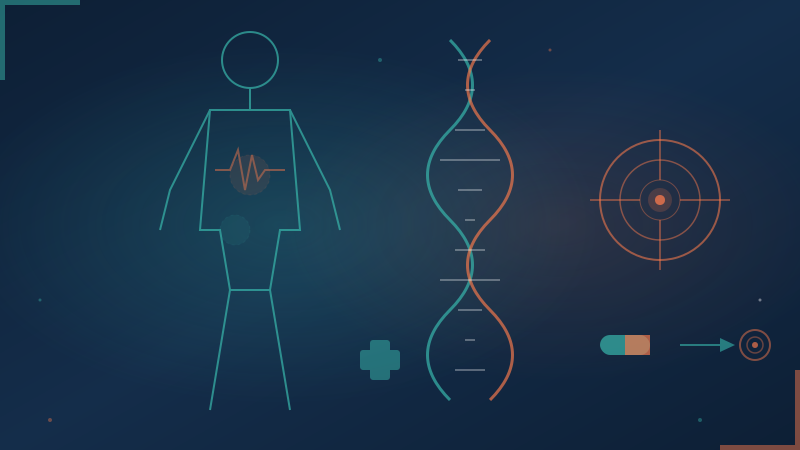
Precision medicine — the approach that personalizes prevention and treatment based on individual patient characteristics — is experiencing an AI revolution. AI's ability to analyze multi-omics data and build complex predictive models is opening unprecedented therapeutic possibilities.
Digital biomarkers
Digital biomarkers are physiological and behavioral measures collected through wearable devices, smartphones, and environmental sensors. AI transforms this raw data into clinically relevant indicators: sleep patterns predicting depressive episodes, typing variations anticipating cognitive decline, voice alterations signaling neurological pathologies.
Patient digital twins
The digital twin concept, born in manufacturing engineering, finds one of its most promising applications in medicine. A patient digital twin integrates genomic, proteomic, metabolomic, clinical, and lifestyle data to create an individual computational model for drug effect simulation and treatment optimization.
Multi-omics and AI
Integrating multi-omics data is a challenge only AI can effectively address. Deep learning models, particularly transformer architectures adapted for biological data, can identify cross-omic patterns invisible to human analysis.
Industry implications
For life sciences companies, precision medicine represents both opportunity and challenge. Adalot supports the sector with technology assessments and feasibility studies balancing ambition and pragmatism.